

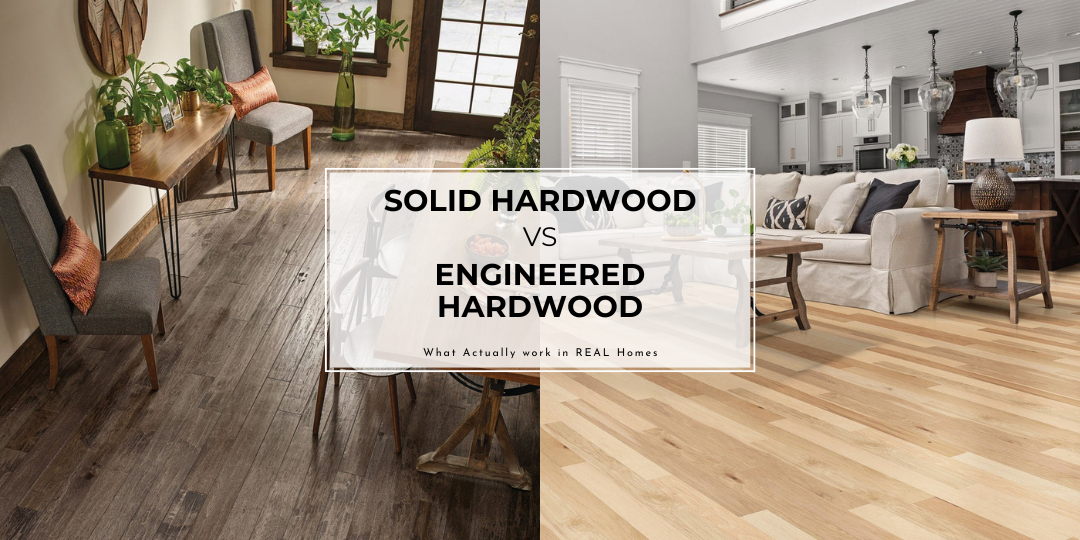
Solid hardwood has long been considered the standard in residential flooring. But that assumption often leads to the wrong choice, especially in homes where humidity, subfloor type, and daily use introduce variables that solid wood does not handle well.
Engineered hardwood was developed to address those limitations. While both options use real wood, they behave very differently once installed. Movement, stability, installation constraints, and long-term performance all depend on that difference.
Choosing between engineered hardwood and solid hardwood is not about which sounds better. It is about which one will remain stable and reliable in your specific environment.
The Real Difference (And Why It Matters)

The difference isn’t just how they’re made, it’s how they behave over time.
Solid hardwood is one piece of natural wood. That means it expands and contracts more with changes in humidity.
Engineered hardwood is built in layers, with a real wood top and a stable core underneath. That layered construction reduces movement.
That one difference shows up in real life as:
- Stability vs movement.
- Predictability vs seasonal changes.
- Compatibility with different subfloors.
This is where most buying decisions go wrong: people focus on appearance, not behavior.
Where Solid Hardwood Starts to Struggle
Solid hardwood performs beautifully in the right conditions. But outside of those conditions, problems start to show.
Common failure points:
- Boards expand, causing cupping or buckling.
- Visible gaps during dry months
- Not a suitable install surface.
- Movement becomes noticeable over time.
In regions with consistent humidity or homes without tight indoor climate control, solid hardwood demands more from the environment than most people realize.
Where Engineered Hardwood Falls Short
Engineered hardwood is often presented as the “safe option,” but it’s not perfect.
Common failure points:
- Limited refinishing ability.
- Weaker feel underfoot.
- Still vulnerable to standing water.
- Shorter lifespan.
The mistake here is assuming all engineered hardwood performs the same. Quality makes a significant difference.
Humidity Changes Everything
Humidity is the deciding factor most homeowners underestimate.
When moisture levels rise:
- Wood expands.
When moisture drops:
- Wood contracts.
Solid hardwood reacts more aggressively to this cycle.
If your home experiences:
- Seasonal indoor humidity swings.
- Frequent door opening (outdoor moisture exchange).
Engineered hardwood becomes the more stable option.
Subfloor Matters More Than Most People Think
Subfloor Matters More Than Most People Think
If your home has a concrete slab
Engineered hardwood is usually the practical choice.
Solid hardwood requires a wood subfloor and isn’t designed for direct installation over concrete.
If your home has a wood subfloor
Both options are possible, but humidity and lifestyle still matter.
Basements and lower levels
Engineered hardwood is the safer route due to moisture exposure risks.
Ignoring subfloor conditions is one of the most expensive flooring mistakes homeowners make.
Installation Flexibility
Installation isn’t just a technical detail, it affects cost, timeline, and compatibility.
Solid hardwood:
- Typically nail-down installation.
- Requires a wood subfloor.
- Less flexible across different home types.
Engineered hardwood:
- Can be floating, glue-down, or nail-down.
- Works across more environments.
- Easier to adapt in renovations.
That flexibility is why engineered hardwood shows up more often in modern homes.
Durability and Daily Life
Both options can handle daily use, but the details matter.
Solid hardwood:
- Can be refinished multiple times.
- Long lifespan when properly maintained.
Engineered hardwood:
- Durability depends on wear layer thickness.
- High-quality products perform very well in active homes.
Most homeowners never refinish their floors more than once.
So while solid hardwood has a longer theoretical lifespan, that advantage only matters if you plan to use it.
Cost: What You’re Actually Paying For
Costs overlap more than people expect.
- Solid hardwood: often higher installation cost due to labor requirements.
- Engineered hardwood: more flexibility can reduce installation complexity.
- Material pricing varies based on quality in both categories.
The real cost difference often comes from:
- Installation method.
- Subfloor preparation.
- Long-term maintenance.
Not just the product itself.
Real-World Scenarios
This is where the decision becomes clear.
If your home has humidity swings
→ Engineered hardwood is more stable
If you’re installing over concrete
→ Engineered hardwood is the practical option
If you want a long-term, refinishable floor
→ Solid hardwood makes sense (in stable conditions)
If you want less risk and easier installation
→ Engineered hardwood is the safer choice
If you have pets and heavy traffic
→ Finish quality matters more than structure
Resale Value: What Actually Matters

Both options can support home value, but context matters.
Buyers care about:
- Appearance.
- Condition.
- Durability.
Solid hardwood carries traditional appeal, but engineered hardwood has become widely accepted, especially when it looks and performs well.
Poor condition hurts value more than the type itself.
Comparison
Quick comparison based on how each floor performs in real home conditions.
|
What Happens in Real Homes |
Solid Hardwood |
Engineered Hardwood |
|
When humidity rises or drops |
Expands and contracts more → can lead to gaps, cupping, or movement over time |
More stable → handles seasonal changes with less visible movement |
|
If your subfloor is concrete |
Not suitable → requires additional structure or different flooring |
Works directly → common choice for slabs and basements |
|
During installation |
Limited options → mainly nail-down, more restrictive setup |
Flexible → floating, glue-down, or nail-down depending on space |
|
Over years of use |
Can be refinished multiple times → long lifespan if conditions stay stable |
Limited refinishing → lifespan depends on wear layer quality |
|
In homes with changing conditions |
Higher risk → depends heavily on climate control |
Lower risk → more forgiving in real-world environments |
|
Best fit overall |
Homes with stable humidity and a proper wood subfloor |
Homes with mixed conditions, renovations, or moisture exposure |
How Floors Center Helps You Choose the Right Hardwood Flooring for Your Home
Flooring issues usually begin when the material is chosen without understanding the type or the environment it’s going into.
At Floors Center, the focus is on matching the flooring to real conditions, not just appearance.
Samples also play a bigger role than most expect. The same floor can look different depending on lighting, surrounding materials, and the layout of the space.
Final Thoughts
Choosing between engineered hardwood and solid hardwood comes down to how your home handles moisture, movement, and daily use. Both options can perform well when matched to the right conditions. Most problems begin when the decision is made on appearance alone.
The right floor is not just the one that looks right today, but the one that continues to perform as your home goes through seasonal changes and everyday use. Making the right choice early helps avoid the issues that tend to surface long after installation.
FAQs
Q) Is engineered hardwood real wood?
A) The top layer is real hardwood. The difference is in the core construction.
Q) Can engineered hardwood be refinished?
A) Yes, but only a limited number of times depending on the thickness of the wear layer.
Q) Which is better for humid climates?
A) Engineered hardwood is generally more stable in humid conditions.
Q) Is solid wood cheaper than engineered hardwood?
A) Sometimes. Solid wood can be cheaper in material cost, but installation is often more expensive. The total cost can end up similar depending on the project.
Q) Why is engineered hardwood more expensive than solid hardwood?
A) Higher-quality engineered hardwood uses better construction and offers more stability, especially in humid conditions. You’re paying for performance and flexibility, not just the material.