

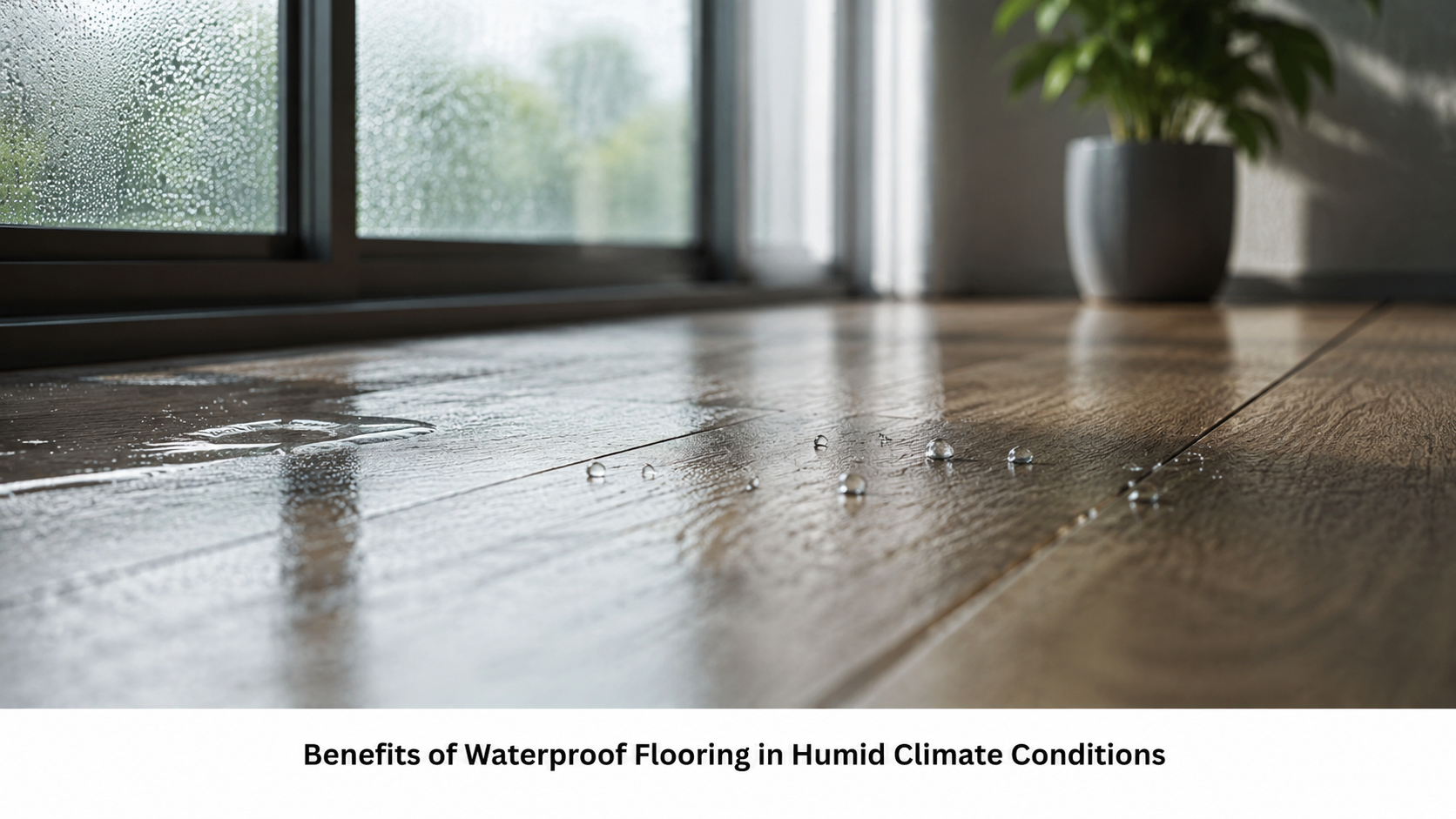
Most flooring problems in humid climates do not start with visible water. They begin with moisture already present in the air.
In consistently humid environments, flooring materials are exposed to moisture long before spills or leaks happen. Over time, that exposure changes how floors behave. Some materials absorb moisture and expand. Others begin shifting at the seams, trap moisture underneath, or develop long-term surface instability.
This is why waterproof flooring performs differently in humid climates. The issue is not just water resistance. It is how the flooring system reacts to continuous moisture exposure over time.
Why Humidity Affects Flooring More Than Most People Expect
Humidity affects flooring gradually rather than instantly.
Air moisture enters porous materials and slowly changes their dimensions. Floors that repeatedly absorb and release moisture can begin expanding, swelling, or shifting, especially in areas where humidity levels stay high throughout the year.
This is different from direct water exposure. Even without visible spills, moisture in the air continues interacting with the flooring surface and the material underneath it.
Homes in coastal regions, poorly ventilated interiors, bathrooms, kitchens, and laundry areas usually experience these conditions more aggressively.
What Happens to Flooring in Constant Humidity
Different flooring materials respond differently to moisture in the air.
Traditional hardwood flooring can expand as humidity rises, which may lead to cupping, gaps, or surface movement over time. Laminate flooring is especially vulnerable around edges and seams because moisture penetration can cause swelling beneath the wear layer.
Floating floors may also react more noticeably in humid environments because the system allows slight movement during expansion and contraction cycles.
In some cases, trapped moisture below the floor becomes a larger problem than the visible surface itself.
Why Waterproof Flooring Behaves Differently
Waterproof flooring is designed to reduce how much moisture penetrates the surface and internal structure of the material.
Luxury vinyl plank flooring, porcelain tile, and certain waterproof flooring systems use non-porous or moisture-resistant layers that remain more dimensionally stable under humid conditions. Instead of absorbing moisture into the core structure, the surface resists penetration more effectively.
This does not mean every waterproof floor performs identically. The installation method, core material, and subfloor preparation still affect long-term performance.
Waterproof Does Not Mean Every Flooring Type Performs the Same
Some waterproof floors perform better than others depending on the environment.
Porcelain tile remains one of the most stable flooring materials in humid climates because it absorbs very little moisture and handles temperature changes well. Properly installed porcelain flooring performs consistently in bathrooms, kitchens, and other high-moisture spaces.
Luxury vinyl plank flooring also performs well because the material itself resists water penetration. Glue down vinyl systems generally remain more stable in humidity than floating click-lock systems because there is less floor movement across the surface.
Engineered hardwood handles humidity better than solid hardwood because of its layered construction, but it still contains real wood and remains sensitive to moisture over time.
Where Humidity Causes the Biggest Flooring Problems
Humidity-related flooring problems are more common in areas where moisture exposure happens repeatedly.
- Bathrooms with poor ventilation.
- Kitchens exposed to steam and cleaning moisture.
- Laundry rooms with trapped humidity.
- Basements with subfloor moisture issues.
- Coastal homes with consistently humid air.
In these spaces, flooring performance depends not only on surface waterproofing, but also on how the entire flooring system handles long-term moisture exposure.
What Most Homeowners Overlook About Humid Climates
Many homeowners focus only on the visible flooring surface and overlook what happens underneath it.
Subfloor moisture, improper underlayment, poor ventilation, and installation gaps all affect how flooring behaves in humidity. Even waterproof materials can experience problems if moisture becomes trapped below the floor system.
This is one reason glue down flooring systems are often used in commercial or high-moisture environments. The reduced movement and tighter bond to the subfloor help create a more stable surface over time.
Humidity problems are usually cumulative. Floors may appear normal initially before expansion, movement, or surface inconsistencies begin developing later.
Which Waterproof Flooring Works Best in Humid Conditions
The best flooring for humid climates depends on how much moisture exposure the space receives.
Porcelain tile performs best in consistently wet or humid environments because of its low absorption rate and long-term stability.
Glue down luxury vinyl flooring performs well in areas where dimensional stability and reduced floor movement are priorities.
Waterproof luxury vinyl plank flooring is commonly used in residential spaces because it combines moisture resistance with easier installation and lower maintenance.
The right choice depends less on appearance and more on how the flooring system behaves under continuous humidity exposure.
Final Thoughts
Humidity affects flooring even when there is no visible water on the surface.
Over time, moisture in the air changes how floors expand, move, absorb, and perform. Waterproof flooring systems reduce these problems by limiting moisture penetration and maintaining better dimensional stability under humid conditions.
The difference is not just whether a floor can resist water. It is how consistently the flooring system performs after years of exposure to humidity.