

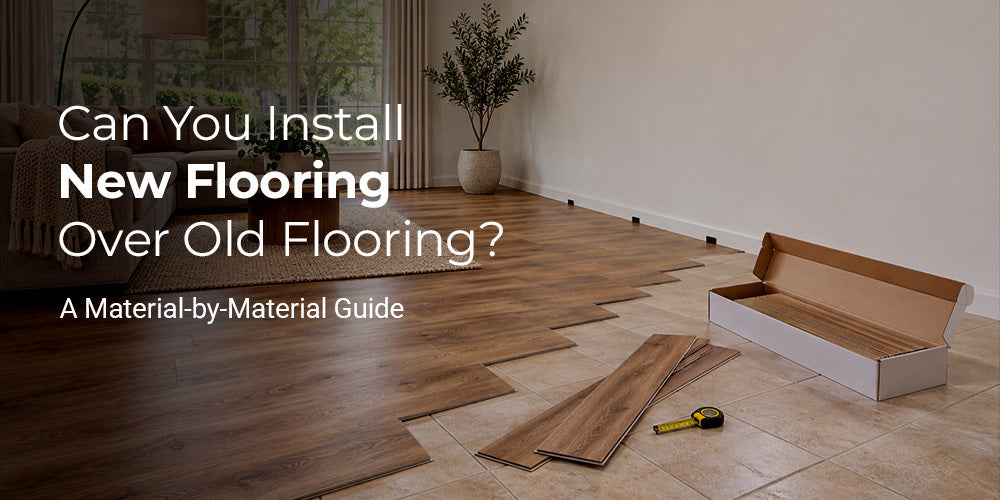
Yes, you can install new flooring over old flooring — but only in some cases, and only if the old floor passes a few key checks. Skip those checks and you risk gaps, squeaks, cracked tile, trapped moisture, or a floor so tall your doors no longer open.
Installing over an existing floor can save demolition time, disposal fees, and a lot of mess. Whether it works depends on what's underneath and what's going on top. This guide covers the essential checks first, then goes material by material so you know what works, what doesn't, and when tearing out is the smarter move.
Why Install Over Existing Flooring? The Benefits and Trade-Offs
Homeowners choose overlays for good reasons, but every shortcut has a cost.
The Upside
- Lower demolition and haul-away costs.
- Less dust, noise, and downtime.
- A faster path from old floor to finished room.
The Trade-Offs
- Added height at doors, transitions, and appliances.
- Hidden damage stays hidden until it causes a bigger problem.
- Prep work like leveling and patching can eat into the savings.
- Some manufacturers' warranties require specific subfloor conditions.
Before You Install: 5 Checks Every Overlay Project Needs

Run through these first. Any one of them can rule out an overlay, and the manufacturer's installation guide always has the final word.
- Condition: The old floor must be solid, firmly attached, and free of water damage, mold, soft spots, or widespread cracking. A new floor can't fix a failing base.
- Flatness: Many floating floors tolerate about 3/16 inch of variation over 10 feet, while tile is stricter at roughly 1/8 inch. Our guide to tiling over a floor that isn't level shows what goes wrong when this step is skipped.
- Moisture: Never cover a damp floor. Trapped moisture causes mold, odors, warping, and adhesive failure. Test concrete slabs before you build on them.
- Height: Every layer adds thickness. Measure door clearances, baseboards, transitions, dishwasher openings, and stair risers before you commit.
- Safety: Resilient flooring and adhesives installed before the 1980s can contain asbestos. Don't sand, scrape, or rip them up. Have a certified professional test them first, because leaving an intact floor undisturbed and covering it is often the safer route.
Three Quick Tests You Can Do Today

- Straightedge test: Lay a 10-foot straightedge or long level on the floor and measure any gaps underneath.
- Tap and walk test: Tap across tile and listen for hollow sounds. Walk over hardwood and vinyl and feel for movement, bounce, or squeaks.
- Plastic sheet test: Tape a 2-foot square of clear plastic to a concrete floor for 24 hours. Condensation underneath points to a moisture problem, though professional testing is more reliable.
Installing New Flooring Over Ceramic or Porcelain Tile
Tile is one of the most common overlay questions, and the answer is often yes, with the right prep.
What Works
- Floating vinyl, laminate, or engineered wood: Works well when the tile is flat and well bonded. Fill deep grout lines with a cementitious patch so they don't telegraph through thinner, flexible planks.
- New tile over tile: Possible when the existing tile is solid, crack-free, and clean. Roughen glossy surfaces, use a thinset rated for the job, and expect to add roughly 3/8 to 1/2 inch of height.
What to Watch For
- Loose, hollow-sounding, or cracked tiles must be repaired or removed first.
- Existing cracks tend to reappear unless you add an uncoupling membrane.
- Lippage (tiles sitting higher than their neighbors) puts uneven pressure on floating click-lock joints.
- Nail-down hardwood isn't an option over tile.
Planning a tile-over-tile refresh? Browse our tile flooring collection to find a new look.
Installing New Flooring Over Hardwood
Existing hardwood makes a strong base, as long as it's flat, secure, and dry.
- Floating vinyl, laminate, or engineered flooring: Usually fine over sound hardwood. Many manufacturers recommend running new planks perpendicular to the old boards.
- Cupped, buckled, or squeaky boards: Fix these first. Screw down loose boards and sand or plane high spots, or the new floor will mirror every flaw.
- Gaps between boards: Wide gaps can show through thin flooring. A quality underlayment can help smooth them out.
- Refinish instead? If the boards are sound and the problem is scratches or a worn finish, refinishing often costs less than covering them.
Ready for something new? Explore our hardwood flooring collection for fresh options.
Installing New Flooring Over Vinyl, LVP, or Sheet Vinyl
Vinyl works as a base only when it's a single, well-bonded layer.
- New vinyl or laminate over vinyl: Works when the old surface is smooth, fully glued down, and only one layer thick.
- Cushioned or embossed vinyl: Remove it first. Soft backing compresses under floating floors and breaks locking joints, and embossed patterns can show through.
- Tile over vinyl: Needs cement backer board fastened through to the subfloor. Thinset won't bond reliably to vinyl.
- Older vinyl or black adhesive: Treat it as possible asbestos. Call a certified professional before sanding, scraping, or removing anything.
Replacing instead? Waterproof options in our vinyl flooring collection suit kitchens, baths, and basements.
Installing New Flooring Over Laminate
The short answer is usually no. Take the old laminate out first.
- Laminate floats on its underlayment. Stacking one floating floor on another creates a soft, shifting base that stresses locking joints and leads to gaps and squeaks.
- Swollen edges signal past water exposure, which you'll want to see and fix before anything goes on top.
- Floating click-lock laminate is among the easiest floors to remove, so teardown often goes faster than expected.
Starting fresh? Our laminate flooring collection covers a wide range of styles.
Installing New Flooring Over Carpet or Concrete
Carpet
Never install hard flooring over carpet. Pull up the carpet, pad, tack strips, and staples first. Carpet and padding compress, trap moisture, and can hide subfloor damage you need to see. Want something soft again? Browse our carpet collection.
Concrete
Concrete is less an old floor than the ideal foundation. Most new floors can go over it once it's prepared:
- Test for moisture and use a vapor-barrier underlayment when the manufacturer requires it.
- Grind high spots and patch low spots to meet flatness tolerance.
- Remove paint, sealers, and old adhesive residue that could block bonding.
Quick Reference: Which Old Floors Can Stay?
Use this table as a starting point, then confirm with your new product's installation guide.
|
Existing floor |
Install over it? |
What it takes |
|
Ceramic or porcelain tile |
Often |
Flat, tight, crack-free; fill deep grout lines |
|
Hardwood |
Often |
Flat, secure, and dry; repair cupped or loose boards |
|
Single-layer vinyl or LVP |
Sometimes |
Smooth and fully bonded; no cushioned backing |
|
Laminate |
Rarely |
Remove it; stacked floating floors fail |
|
Carpet |
No |
Remove carpet, pad, and tack strips |
|
Concrete |
Yes |
Dry, clean, and flat; test moisture first |
Best New Floors for Overlay Projects
If you're covering an existing floor, thinner and floating usually wins.
- Rigid-core vinyl plank: A stiff core hides minor surface flaws better than thin, flexible vinyl, and it installs without glue.
- Laminate: Click-lock planks float over underlayment and add modest height, but they need a flat base.
- Engineered hardwood: Floating or glue-down options give you a real-wood look at a manageable thickness.
When to Tear Out the Old Floor Instead
Covering a problem rarely solves it. Remove the old floor when you find any of these:
- Moisture, mold, or a persistent musty smell.
- Soft, spongy, or loose areas underfoot.
- Two or more layers of flooring already stacked.
- Extra height you can't absorb at doors, appliances, or stairs.
- Unevenness beyond what the new product's installation guide allows.
Common Mistakes When Installing Over Old Flooring
- Assuming underlayment can fix an uneven floor. It cushions but doesn't level.
- Covering moisture instead of fixing the source.
- Forgetting door clearances, baseboards, and transitions until the floor is already down.
- Ignoring the manufacturer's substrate requirements, which can void the warranty.
- Ordering exactly the square footage with no overage for cuts and waste.
Final Thoughts
You can often install new flooring over old flooring, but the old floor has to earn its place. Check condition, flatness, moisture, height, and safety first. Tile and hardwood are usually good candidates, single-layer vinyl is workable, and laminate and carpet should come out.
Still unsure? Contact the Floors Center team with your current floor type and the product you're considering, and we'll help you decide whether an overlay makes sense. For more practical guides, browse the Floors Center Floor Blog.
FAQs
Q) Do I need underlayment when installing over old flooring?
A) Usually, for floating floors. Underlayment adds cushioning, sound control, and sometimes a moisture barrier. Skip it only if your flooring has attached padding.
Q) How much height will a new floor add?
A) A floating vinyl or laminate floor with underlayment typically adds about 1/4 to 1/2 inch. Tile over tile adds more. Measure your transitions before you buy.
Q) Is installing over old flooring cheaper?
A) It can be. You save on demolition and disposal, but leveling and patching add some cost back. It pays off mainly when the old floor is a sound base.
Q) Can I install over old flooring in a bathroom or kitchen?
A) Yes, if the old floor is dry, intact, and free of water damage. These rooms hide moisture problems, so inspect carefully, and choose water-resistant materials like vinyl or tile for the new floor.
Q) Does installing over old flooring void my warranty?
A) It can. Many manufacturers list approved subfloors and flatness limits, and installing over an unapproved surface may void coverage. Read the warranty terms before you start.