

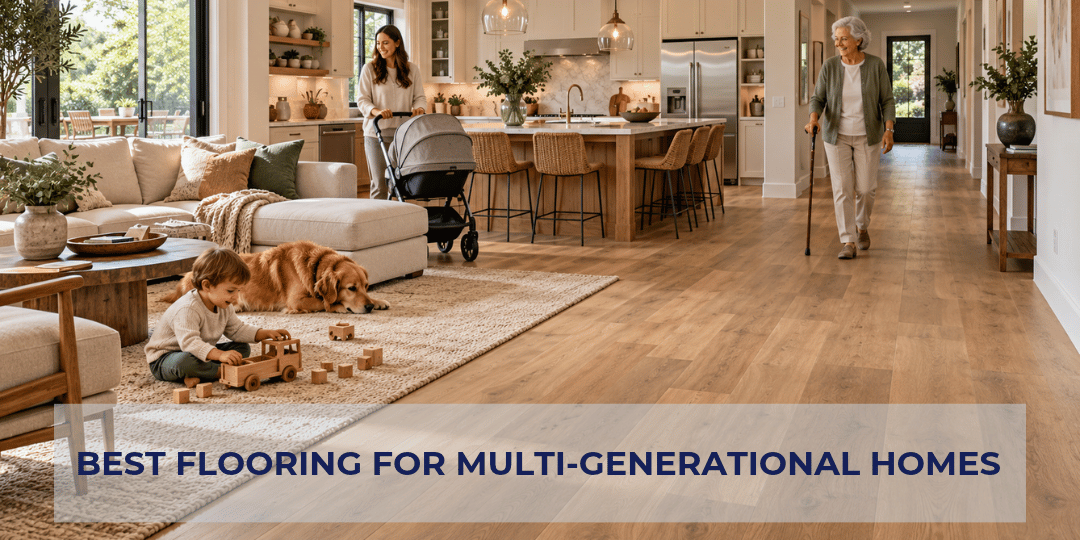
One floor, three generations, very different needs
The short answer: a wide-plank luxury vinyl floor with a textured, matte surface, run continuously through the main living areas with flush transitions, satisfies almost every requirement a multi-generational household has, and it does not look like a hospital corridor.
Getting there takes some thought, because the people walking on this floor want contradictory things. A grandparent needs grip underfoot and something forgiving if they fall. A parent pushing a stroller, or a wheelchair, needs a hard, smooth surface that rolls without resistance. A toddler needs something warm to sit on that survives juice. And everyone wants the house to look like a home, not a care facility.
Those needs are not actually in conflict once you know which specifications matter. Slip resistance and style are independent variables. So are cushioning and cleanability. The homes that get this wrong usually got there by choosing on appearance alone and then discovering, two years later, that the polished porcelain in the entry is treacherous in wet shoes.
This guide covers what to specify, which materials deliver it, how to handle each zone of the house, and how to keep the result genuinely attractive.
Seven things a multi-generational floor has to do

- Resist slips, especially when wet. For tile, look for a DCOF rating of 0.42 or higher, that is the industry threshold for level interior floors expected to get wet. On vinyl and wood, the equivalent signal is surface texture: an embossed or wire-brushed finish grips better than a smooth, high-gloss one. Matte beats polished every time in a household with older adults. DCOF is an important comparison point, but it does not guarantee that a tile will be safe in every wet environment. Learn how to read DCOF slip-resistance information before choosing bathroom, entryway or laundry-room tile.
- Soften a fall. Falls are the leading cause of injury for adults over 65, and the floor decides how badly one ends. Resilient materials — cork, vinyl over a padded underlayment, rubber — absorb impact. Ceramic and stone do not. This is the strongest argument against running tile through bedrooms and hallways where night-time walking happens.
- Let wheels roll. Walkers, wheelchairs, rollators and strollers all need a firm, flat, low-resistance surface. Hard flooring is better than any carpet. If carpet is required, specify a low, dense pile of 1/4 inch or less with no separate pad, which is what commercial-grade carpet tile delivers.
- Eliminate trip hazards at transitions. Every change of material is a potential fall. Accessibility guidance generally calls for thresholds no higher than 1/4 inch, or up to 1/2 inch if bevelled. The easiest way to meet it is to not create transitions at all — run one material continuously and use matched-height underlayment where materials must meet.
- Provide visual contrast where it matters. Ageing eyes lose contrast sensitivity. Keep the floor one consistent tone through an open space, then contrast it clearly against walls, stair nosings and the first and last step of any staircase. Avoid busy, high-variation patterns that can read as steps or obstacles to someone with low vision or dementia.
- Control sound. Multi-generational homes are noisy, and often vertically stacked — grandparents sleeping below a child's bedroom. Acoustic underlayment under a floating floor is a cheap fix made at install time and impossible to retrofit later.
- Stay clean without heroics. Spills, pets, mobility aids and wet shoes all arrive. Choose a surface a household member can maintain with a damp mop and no specialist product, no waxing and no resealing schedule.
The best materials, ranked for multi-generational living

1. Luxury vinyl plank — the best all-round answer
Waterproof vinyl flooring hits more of the seven requirements than anything else. It is softer and warmer underfoot than tile, so a fall is less severe and a child on the floor is comfortable. It is completely waterproof, so bathroom accidents and spilled drinks are a wipe rather than a repair. Textured, matte finishes give real grip. And it rolls beautifully under wheels.
The practical advantage is continuity. When the selected product is approved for every intended room, one vinyl plank style can sometimes continue through the main floor plan and reduce unnecessary transitions. Choose SPC flooring for a dense, stable core that handles heavy mobility equipment, or WPC flooring when you want more cushioning and quieter footfall overhead.
If you are deciding between the two core types, compare SPC and WPC flooring based on rigidity, comfort, sound and resistance to dents.
2. Cork — the fall-safety specialist
Cork flooring can feel warmer, quieter and more resilient underfoot than rigid tile or stone. Its cellular structure compresses on impact, which measurably reduces injury from falls, and it insulates against both cold and sound. It is naturally warm underfoot, which matters for older adults with poor circulation.
The trade-offs are real: cork dents under heavy furniture, fades in strong sunlight, and most products need resealing every few years. It is an excellent choice for a ground-floor bedroom or a dedicated grandparent suite, and a questionable one for a busy kitchen.
3. Engineered hardwood — style without the instability
When the house needs to look like a family home rather than an adapted one, engineered hardwood flooring delivers. Specify a matte or satin finish with visible texture; skip the high-gloss options, which are slippery and show every scuff. A wire-brushed surface in a mid-tone oak is both the most forgiving underfoot and the most forgiving of dust and pet hair.
It is less water-tolerant than vinyl, so pair it with tile or vinyl in bathrooms and laundry rooms and plan those transitions carefully. Compare with solid hardwood, which moves more with humidity and is harder to keep flush at doorways.
4. Textured porcelain tile — for wet zones only
Tile is the right answer in bathrooms, entries and laundry rooms, where water is constant. The requirement is a slip rating of DCOF 0.42 or above and a matte, structured surface, not polished. Smaller formats with more grout lines add grip, though they also add cleaning. Browse bathroom floor tile options and confirm the selected product’s wet-area application and slip-resistance information before ordering.
Do not run tile through bedrooms and hallways. The fall risk outweighs the durability benefit in exactly the rooms where night-time walking happens.
5. Low-pile carpet — in bedrooms, with limits
Carpet reduces fall injury and absorbs sound, which makes a case for it in private bedrooms. If you use it, specify a dense commercial-grade loop pile of 1/4 inch or less with no thick pad. Deep, plush carpet does the opposite of what you want: it catches walker legs, resists wheels, and hides the floor's edge.
What to avoid
Polished and high-gloss surfaces. Polished porcelain, glossy vinyl and high-sheen wood all become slick when wet and produce glare that is genuinely disorienting for ageing eyes. Matte and satin finishes solve both problems at no extra cost.
Thick, plush carpet. It feels safe and behaves badly. Deep pile grabs at walker legs and wheelchair castors, hides the transition between rooms, and traps the allergens that matter in a house with both young children and older adults.
Raised thresholds and transition strips. The small aluminium strip between two rooms is the most common trip hazard in a retrofitted house. Plan material heights at the design stage so transitions sit flush, and use bevelled reducers where a height change cannot be avoided.
Some transitions are still needed where flooring materials, heights or installation systems change. Read our guide to when transition strips are required before removing or avoiding them.
Loose rugs. A rug without a bonded non-slip backing is a fall waiting to happen. If a household wants rugs for warmth or definition, use low-profile ones with a full-coverage grip pad and taped edges.
Busy, high-contrast patterns. Strong patterns, dramatic plank-to-plank colour variation and bold borders can read as level changes or holes to someone with dementia or reduced vision. Keep the field quiet; save the contrast for stair nosings and walls where it does useful work.
Zone by zone
|
Zone |
Recommended |
Why it wins here |
|
Entry and mudroom |
Textured porcelain tile or 20 mil vinyl plank |
Wet shoes arrive here; slip rating matters most |
|
Open living and dining |
Wide-plank vinyl or matte engineered wood |
One continuous surface, no transitions to trip on |
|
Kitchen |
Waterproof vinyl plank |
Cushioned underfoot for long standing, waterproof under appliances |
|
Main-floor bedroom or suite |
Cork or vinyl with acoustic underlayment |
Fall cushioning plus sound isolation where it counts |
|
Bathroom |
Slip-rated matte porcelain or waterproof vinyl |
Grip when wet; vinyl keeps the floor flush with the hallway |
|
Hallways |
Same material as living areas |
Continuity removes thresholds along the main night-time route |
|
Stairs |
Matched treads with contrasting nosing |
The nosing contrast is the single highest-value safety detail |
|
Children's play areas |
Vinyl plank with a rug on a grip pad |
Warm and washable; the rug stays put |
A thicker wear layer can provide more protection against gradual surface wear, but it does not determine slip resistance, dent resistance or overall plank quality. Compare 12 mil vs. 20 mil LVP wear layers before choosing vinyl for busy entrances and shared living areas.
The main-floor suite deserves extra thought
If one generation is living on the ground floor, treat that suite as its own project. The route from bed to bathroom should be a single material with no threshold, adequately lit at night, and clear of rugs. Getting this one path right prevents more injuries than any other flooring decision in the house.
Stairs are where contrast earns its keep
Mark the leading edge of every tread with a nosing that contrasts clearly against the tread itself, and make sure the top and bottom steps are visually obvious. Depth perception is the first thing to go, and a uniform staircase in a single wood tone is genuinely hard to read.
Keeping it beautiful, not clinical
Nothing on the list above requires an ugly house. The accessible choice and the designer choice are usually the same choice, described differently.
Wide planks read as luxury and reduce seams. A 7- or 9-inch plank is the current high-end look and happens to mean fewer joints for a cane tip to catch. Run them lengthwise down the longest sightline and the space looks bigger.
Continuous flooring is a design trend, not a compromise. Open-plan homes have been moving toward one material throughout for a decade because it makes spaces feel larger. That the same decision removes every threshold is a bonus.
Matte finishes are what designers specify anyway. The high-gloss look dated years ago. A matte, wire-brushed oak is both the safer surface and the more current one.
Texture does the work colour used to. Instead of bold pattern, get interest from embossed grain, subtle tonal variation within a narrow range, and a well-chosen trim. The floor stays calm and legible while still looking considered.
Warm mid-tones hide the most. Mid-tone oaks and warm greys conceal dust, pet hair and the occasional scuff from a walker far better than either very pale or very dark floors, which is why they photograph well and why they stay looking new.
Before you buy
- Walk the night-time route first. Trace the path from each bedroom to the nearest bathroom and plan that run as one continuous material. Everything else is secondary.
- Ask for the DCOF number on any tile. If a supplier cannot give you one, that product is not specified for a household with older adults.
- Order acoustic underlayment with the floor. It costs little at install and cannot be added afterwards without pulling the floor up.
- Order 10% extra and keep it. Mobility equipment marks floors. Spare planks mean a single-board repair years later, when the SKU is discontinued.
- Test a sample wet. Put a sample on the floor, wet it, and walk on it in socks and in slippers. Five minutes here beats any specification sheet.
- Plan for change. Needs in a multi-generational home shift over time. A floor that already works for a wheelchair does not need redoing when one is needed.
Ready to compare options? Browse waterproof vinyl flooring, floor planks, engineered hardwood flooring and bathroom floor tile at Floors Center. Review the selected product’s application, surface, installation, maintenance and accessibility requirements with the appropriate professionals before ordering.
Frequently asked questions
Q) What is the safest flooring for elderly parents living at home?
A) Textured luxury vinyl plank over a resilient underlayment is the best overall choice: it grips when wet, cushions a fall better than tile or stone, rolls easily under walkers and wheelchairs, and can run threshold-free through the whole floor. Cork is the single most fall-forgiving option and works well in a bedroom or private suite, though it needs more maintenance than vinyl.
Q) Is vinyl plank or tile better for accessibility?
A) Vinyl plank, in most rooms. Tile is harder, colder and less forgiving in a fall, and its grout lines add a small amount of rolling resistance. Tile earns its place in bathrooms, entries and laundry rooms where constant water makes a slip-rated surface essential, and there you want a matte, structured tile rated DCOF 0.42 or higher, never a polished one.
Q) What flooring is best for wheelchairs and walkers?
A) A hard, flat, firmly supported surface: rigid core vinyl plank, engineered wood or tile all work well. Avoid carpet with a separate pad, deep pile, and any threshold over 1/4 inch. If carpet is unavoidable in a bedroom, use a dense commercial loop pile of 1/4 inch or less glued directly down.
Q) How do I make flooring accessible without the house looking institutional?
A) Specify matte finishes, wide planks and one continuous material through the main living areas, all of which are current design preferences anyway. Put the visual contrast where it does safety work, on stair nosings and against walls, rather than in the floor pattern itself. Done this way, nobody reads the result as an adaptation.
Q) Should I use area rugs in a multi-generational home?
A) Only with a full-coverage non-slip pad and low profile edges, and never along a main walking route or at the top or bottom of stairs. Loose rugs are one of the most common causes of falls among older adults. Where warmth or zoning is the goal, a floor with an acoustic underlayment and a warmer material like cork or WPC vinyl is a safer way to get it.