

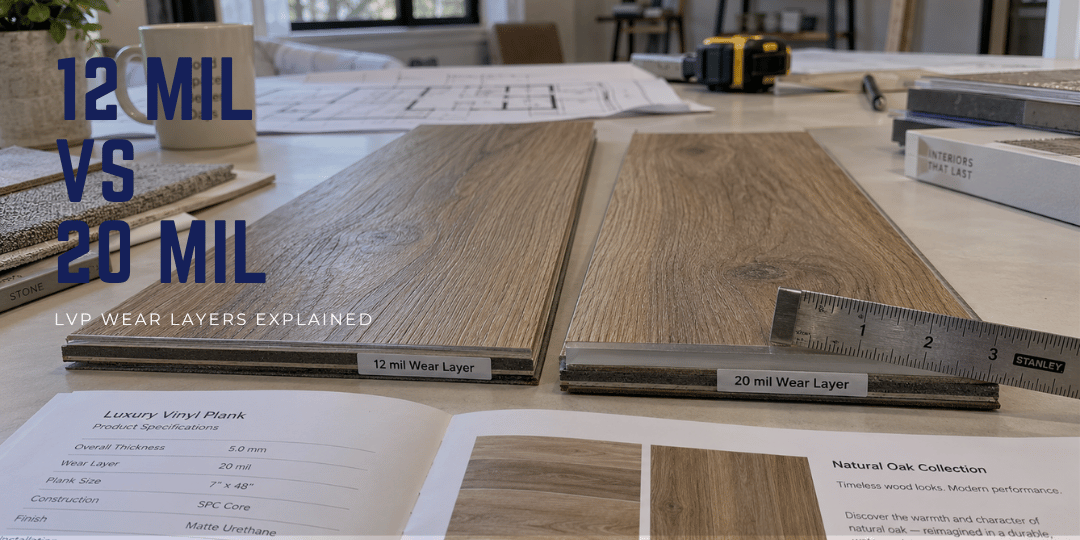
When shoppers compare luxury vinyl plank flooring, 12 mil and 20 mil often look like simple durability grades. A thicker wear layer generally gives the printed design more protection against gradual surface wear, but the number does not tell the whole story. It does not describe plank thickness, waterproofing, dent resistance or installation quality.
For many normal homes, 12 mil LVP is a sensible, cost-effective choice. A 20 mil product becomes more valuable when the floor will face pets, children, frequent entertaining, rolling traffic, rental turnover or light commercial use. The best purchase is not automatically the thickest specification; it is the product whose complete construction matches the room.
What Is the Wear Layer on LVP

Luxury vinyl plank is built in layers. Above the visual film sits a transparent protective wear layer. This is the surface designed to absorb routine foot traffic, cleaning and minor abrasion before wear reaches the printed design underneath.
Manufacturers may add urethane, ceramic-bead or other performance coatings above or within this layer. Those treatments can influence stain resistance, scratch performance and cleaning, so two products with the same wear-layer thickness may not behave identically.
What Does Mil Mean
A mil is one-thousandth of an inch. It is not a millimeter and it is not the total thickness of the plank.
|
Wear layer |
Thickness in inches |
Approximate millimeters |
|
6 mil |
0.006 in |
0.15 mm |
|
12 mil |
0.012 in |
0.30 mm |
|
20 mil |
0.020 in |
0.51 mm |
|
28 mil |
0.028 in |
0.71 mm |
A 20 mil wear layer is therefore about 0.020 inch thick. The entire plank may be 4 mm, 5 mm, 6 mm or thicker depending on its core, backing and attached pad. Do not compare a 20 mil wear layer with a 5 mm total plank thickness as though they measure the same thing.
12 Mil vs 20 Mil LVP at a Glance
|
Factor |
12 mil LVP |
20 mil LVP |
|
Typical fit |
Normal residential use |
Busy residential and many light commercial spaces |
|
Household traffic |
Low to moderate |
Moderate to heavy |
|
Pets and children |
Suitable with sensible care |
More protection for active households |
|
Rental properties |
Works in lower-turnover units |
Often preferred for repeated turnover |
|
Price |
Usually lower |
Usually higher |
|
Surface wear margin |
Good |
Greater |
|
Best buying approach |
Value-focused residential specification |
Extra protection where traffic justifies it |
When 12 Mil LVP Is Usually Enough

A 12 mil wear layer can be a good fit for bedrooms, home offices, guest rooms, dining rooms and many living areas. It is also reasonable for households with moderate traffic when shoes, grit, furniture movement and cleaning are managed properly.
- Owner-occupied homes with ordinary daily traffic.
- Bedrooms and guest rooms.
- Low-traffic upstairs spaces.
- Households without large, highly active pets.
-
Projects where a dependable residential product offers better value than an unnecessary commercial-style specification.
Choosing 12 mil does not mean accepting a weak floor. A well-made 12 mil product with a stable core, strong locking system, appropriate finish and correct installation can outperform a poorly constructed product carrying a larger wear-layer number.
Click to see some popular 12 MIL LVPs available on Floors Center:
-
Chesapeake Pro Solutions SPC 12 Mil 7" x 48" Vinyl Plank
-
Happy Feet International Urban Design 7" x 48" - 12 mil Vinyl Plank
-
Shaw Distinction Plus 7" x 48" 12 mil WPC Vinyl Plank
When 20 Mil LVP Is Worth the Upgrade
Twenty mil LVP is useful when the floor will receive more frequent or more abrasive use. The additional material above the design layer creates a larger wear margin, which can help the floor maintain its appearance through heavier traffic.
- Homes with large dogs or several pets.
- Busy kitchens, hallways, mudrooms and entryways.
- Families with children and frequent guests.
- Rental properties with repeated move-ins and furniture changes.
- Home-based workspaces with regular customer traffic.
- Many light commercial applications when the product warranty permits them.
The upgrade is most defensible when traffic is predictable and sustained. Paying more for 20 mil in a rarely used guest room may deliver little practical benefit, while using 12 mil in a busy rental entrance may create avoidable risk.
Click to see some famous 20 MIL LVP collections on Floors Center:
-
MS International Laurel 9" x 48" Low Gloss Vinyl Plank 20 Mil
-
Shaw Three Rivers 6" x 48" -20 mil Luxury Vinyl Plank
-
Happy Feet International Urban Design 7" x 48" - 20 mil Vinyl Plank
Does 20 Mil LVP Resist Scratches Better
Usually, a thicker wear layer provides more material before abrasion can reach the decorative film. However, scratch resistance depends heavily on the top coating, texture, gloss level, maintenance and the type of debris crossing the floor. A thick wear layer is not scratch-proof.
Sand and grit can act like sandpaper. Unprotected chair legs, dragging appliances and sharp pet claws can mark any resilient floor. A quality surface coating on a 12 mil product may perform better against certain scratches than a basic finish on a 20 mil product, which is why the technical sheet and warranty matter.
Wear Layer Does Not Control Every Type of Damage
Dents and concentrated loads

Dent resistance depends more on the core construction, total plank design, substrate support and the pressure created by furniture or appliance feet. A thicker wear layer does not prevent a soft core from compressing.
Joint failure
The wear layer does not strengthen a weak locking profile or correct an uneven subfloor. Excessive deflection, improper tapping, poor expansion planning and rolling loads can stress joints regardless of whether the surface is 12 mil or 20 mil.
Water damage
Many LVP products are marketed as waterproof because the plank itself does not absorb water like wood-based flooring. That does not make the room or subfloor waterproof. Moisture can still travel through perimeter gaps, damaged joints and penetrations.
Fading and discoloration
Sunlight, heat, rubber-backed mats, chemicals and incompatible cleaners can affect appearance. Review the manufacturer's care guidance and use suitable window treatments where strong sunlight is persistent.
Five Specifications to Compare Besides Wear Layer
1 Total plank thickness
Total thickness can influence feel, locking-profile dimensions and tolerance for minor substrate texture, but thicker is not automatically better. Installation requirements still control subfloor flatness.
2 Core construction
SPC cores are dense and dimensionally stable but can feel firm. WPC products often feel warmer and more forgiving underfoot. Traditional flexible LVT behaves differently again. Choose the construction for the room, not only the wear-layer number.
3 Surface coating
Look for clear manufacturer information about the urethane or enhanced coating. Marketing names vary, so use documented performance and care instructions instead of assuming every ceramic-bead or enhanced finish is equivalent.
4 Locking system and installation method
A precisely milled locking system and correct installation can be more important to long-term performance than an extra eight mils of wear layer. Glue-down and click-lock products also respond differently to rolling loads and repairs.
5 Warranty and approved use
A lifetime residential warranty does not guarantee lifetime appearance or cover every scratch, dent, installation error or moisture condition. Compare exclusions, commercial-use approval, labor coverage and maintenance requirements.
Room by Room Recommendations
|
Room or use |
Suggested starting point |
Why |
|
Bedroom or guest room |
12 mil |
Traffic is usually limited |
|
Living room |
12 or 20 mil |
Choose by household activity and pets |
|
Kitchen |
20 mil for busy homes |
Frequent traffic, chairs, spills and grit |
|
Hallway or entry |
20 mil |
Concentrated traffic and outdoor debris |
|
Laundry room |
12 or 20 mil approved product |
Moisture, appliance loads and movement matter more than wear alone |
|
Rental property |
20 mil often preferred |
Turnover and unpredictable use |
|
Light commercial |
20 mil or specified commercial product |
Use and warranty must match the application |
Pets Kids and Rolling Chairs
Pet households should assess more than claw contact. Large dogs bring grit indoors, run through turns and may spill water around bowls. Twenty mil gives a larger wear margin, but regular sweeping, trimmed claws and protective mats still matter.
Children add toy movement, spills and concentrated activity. Again, 20 mil can be a sensible upgrade in family rooms and kitchens, while 12 mil may remain completely suitable in bedrooms.
Rolling office chairs create repeated pressure and abrasion. Confirm that the specific product is approved for casters, use a manufacturer-compatible chair mat where recommended, and keep the subfloor flat. Wear-layer thickness alone does not protect the locking joints from unsuitable rolling loads.
Is a Thicker Wear Layer Always Better
It is better only when the added protection addresses a real use condition and the rest of the product is equally suitable. A 20 mil product can be a smart investment, but it should not distract from core quality, finish technology, dimensional stability, installation system and warranty coverage.
The most useful buying question is not simply, Which number is bigger? Ask, What will this floor face every day, and which complete product is documented for that use?
How to Choose Without Overpaying
- Map traffic by room instead of buying one specification automatically for the entire property.
- List the real risks: pets, grit, rolling chairs, rental turnover, direct sunlight, moisture and heavy furniture.
- Compare technical data sheets, not only website badges.
- Check the approved residential or commercial use and read warranty exclusions.
- Order samples and view texture, sheen and color in the actual room.
- Budget for subfloor preparation and professional installation where needed.
- Keep spare planks from the same production lot for future repairs.
If the price difference is modest and the room is genuinely busy, 20 mil often provides worthwhile peace of mind. If traffic is light and the 12 mil product is otherwise better built, the lower specification may be the smarter purchase.
Common Buying Mistakes
- Confusing mil with millimeters.
- Assuming wear layer equals total plank thickness.
- Treating waterproof as a waterproof installation.
- Buying 20 mil while ignoring a weak core or locking system.
- Choosing only by warranty length.
- Ignoring subfloor flatness and moisture requirements.
- Expecting any LVP to resist dragging appliances or embedded grit without damage.
Final Recommendation
Choose 12 mil LVP for many normal residential spaces where traffic is controlled and value matters. Choose 20 mil LVP for active families, homes with pets, busy entrances, kitchens, rental units and appropriate light commercial settings. In either case, select the complete product, not the wear layer in isolation.
Review the surface coating, core, total thickness, locking system, installation instructions and warranty before ordering. Then prepare the subfloor correctly and maintain the finished floor with approved products.
Compare available luxury vinyl plank flooring and waterproof vinyl flooring at Floors Center.
Frequently Asked Questions
Q) Is 12 mil wear layer good for LVP?
A) Yes. Twelve mil is suitable for many residential bedrooms, living rooms and offices when the product is well made and the floor receives normal care.
Q) Is 20 mil LVP good for dogs?
A) It is often the better starting point for large or active dogs because it provides more wear material. It is not scratch-proof, so remove grit, trim claws and protect high-activity areas.
Q) How long does a 12 mil wear layer last?
A) There is no reliable universal lifespan. Traffic, maintenance, surface coating, installation, grit and product quality all influence service life.
Q) Can 12 mil LVP be used in a kitchen?
A) Yes, if the manufacturer approves the application. For a very busy kitchen, 20 mil may provide a more comfortable wear margin.
Q) Is 20 mil commercial grade?
A) Many 20 mil products carry light commercial warranties, but the number alone does not make a floor commercial grade. Confirm the exact product's approved use.
Q) Does a thicker wear layer make LVP more waterproof?
A) No. Wear-layer thickness protects the printed design from surface wear. Waterproof claims relate to the plank construction and do not make the full room waterproof.
Q) What is better 12 mil or 20 mil?
A) Twenty mil provides more wear protection, while 12 mil often provides better value in moderate residential spaces. The better choice depends on the room and complete product construction.