

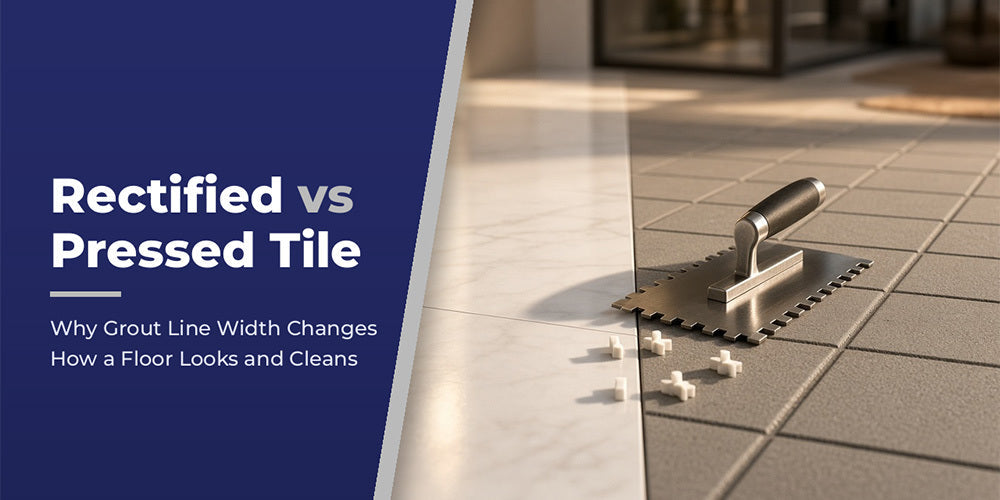
Most people treat the word “rectified” on a tile box like a quality badge. It is not. It is an edge treatment. That one factory step decides how tight your grout lines can be, how the finished grid reads across a room, and how much grout you will scrub for the next decade.
Pressed tile is formed in a mold and fired. The faces are close in size, but the edges are slightly rounded and the dimensions vary a little from piece to piece. Rectified tile is fired first, then the edges are mechanically cut so the faces are squarer and more consistent. The porcelain body can be the same. The difference is the edge.
If you are ordering 12x24, 24x24, or 24x48 porcelain, this spec is the difference between a slab-like floor and a floor that still looks like tile. It is also the difference between a joint that hides dirt and a hairline that shows every dip in an old slab.
What “rectified” actually means
After firing, a saw or grinding line trims each edge so the tile is closer to a true rectangle. Corners sit nearer to 90 degrees. Face dimensions stay inside a tighter tolerance. That is why a manufacturer can recommend a 1/16 inch or 1/8 inch joint instead of 3/16 inch.
Pressed tile, sometimes labeled calibrated or non-rectified, skips that extra cut. The edge has a slight pillow. Two tiles from the same box can differ by a fraction you will not notice in your hand and will notice in a 20-foot run if you force a tight joint.
Three things rectified is not, because product pages mix the language:
- It is not a finishTight joints sell the slab illusion. Veining can run across tiles instead of stopping at a fat gray frame. That is why 24x48 and 48x48 rectified porcelain is the default for the “looks like one piece of stone” brief. Put a 1/4 inch joint on the same tile and it turns back into a tiled floor. The surface did not change. The grid did.. Honed, matte, polished, and grip porcelain can all be rectified.
- It is not a body type. Ceramic and porcelain both come pressed or rectified.
- It is not automatically better porcelain. It is a tighter edge and a tighter install.
On Floors Center product titles the word sits in the name for a reason. Landmark Soul 12x24 Rectified Matte Porcelain and Tesoro Mother of Pearl 12x24 Rectified Polished are telling the installer what joint is possible. Tesoro Marrakech 2x8 Pressed Glossy Brick is telling you the opposite: the grout is part of the design. Read the word as an installation instruction, not a luxury claim.
Grout joint width in practice
Grout is not only a color choice. It is the buffer that lets an installer keep lines straight when tiles are not identical and the floor is not perfectly flat. Industry practice is more conservative than showroom photos.
|
Tile edge |
Typical joint |
How the floor reads |
When to widen |
|
Pressed / non-rectified |
3/16 in. to 1/4 in. |
Classic grid; grout is part of the pattern |
Offset layouts, budget ceramics, wavy slabs |
|
Rectified, stacked, flat floor |
1/16 in. to 1/8 in. |
Near-slab; joints recede |
Only if the manufacturer allows 1/16 in. and the slab is flat |
|
Rectified, large-format or offset |
1/8 in. is often safer than 1/16 in. |
Still clean, less lippage risk |
24x48, 48x48, brick-lay, older houses |
Tile handbook language treats 1/8 inch as the practical minimum for many rectified floors, then adds whatever warp exists on the long edge. A 1/16 inch joint is a design choice, not a right. It only works when the tile, the substrate, and the installer all cooperate.
The same spacer looks smaller on a rectified edge than on a pressed edge. Pressed tile has a rounded shoulder, so grout climbs the curve and the joint reads wider after it is packed. If you want a thin-line look without fighting a 1/16 inch spec, choose rectified tile and use a clean 1/8 inch joint.
How grout width changes the look of the floor

Marble-look and stone-look porcelain
Tight joints sell the slab illusion. Veining can run across tiles instead of stopping at a fat gray frame. That is why 24x48 and 48x48 rectified porcelain is the default for the “looks like one piece of stone” brief. Put a 1/4 inch joint on the same tile and it turns back into a tiled floor. The surface did not change. The grid did.
Grout color multiplies the effect. A joint that matches the field almost disappears. A contrasting joint draws a map over the room. Decide that in a dry layout, not from a 2-inch chip on a phone.
Wood-look planks
A hairline joint keeps a porcelain plank reading as a floorboard. A rustic, contrasting grout line can look intentional on a distressed wood-look and wrong on a clean oak look. Match joint width to the story the surface is telling. If the plank is rectified and you then ask for a wide, high-contrast grout, you paid for an edge you are not using.
Patterned, mosaic, and small-format pressed tile
Busy surfaces hide grout. Zellige-look, brick, and mosaics often want the joint as part of the design. Forcing those products into a 1/16 inch joint fights the edge and the handmade feel. Pressed is not the consolation prize here. It is the correct edge. A 2x8 pressed glossy brick with a 1/8 inch or 3/16 inch joint looks like a crafted wall. The same brick jammed tight looks like a factory panel that missed a step.
How grout width changes how the floor cleans

Grout is the porous, stainable part of the assembly. More joint width means more surface that can darken, and more lines for a mop to miss. That is the part homeowners feel six months later, after the install photos are forgotten.
- Wider joints on pressed tile collect more soil in kitchens and entries. Plan on a stain-resistant cement grout or an epoxy grout if the room sees oil, coffee, or muddy shoes.
- Narrow joints on rectified tile still stain if you pick a light, cementitious grout and never seal it. Tight is not self-cleaning.
- Sanded grout is the workhorse above about 1/8 inch. Unsanded grout or a fine-joint product is what actually packs a 1/16 inch line. Do not force sanded grout into a hairline. It will not fill, and the voids collect dirt.
- Dark grout hides dirt and can flatten pale marble-look tile. Light grout looks custom and shows every splash. Choose the color from a dry layout in the room’s light.
If easy cleaning is the real goal, joint width matters less than grout chemistry. A 3/16 inch epoxy joint on pressed tile can stay cleaner than a 1/16 inch cement joint on rectified tile. The modern thin line is not automatically the low-maintenance line. Cement grout still needs sealing in kitchens, showers, and entries. Epoxy costs more up front and skips most of that work.
The tradeoff shoppers miss: lippage and a wavy slab
Lippage is the small step between two neighboring tiles. A wide joint shadows that step. A hairline joint spotlights it. Afternoon sun across a large-format floor will show every ridge you ignored during install. Rectified edges make that harsher, not gentler. The square cut casts a crisp shadow. Pressed pillow edges soften the same height difference.
Do not specify 1/16 inch on an older house, a basement slab, or any floor that has not been flattened to the tile manufacturer’s requirement. Large-format rectified porcelain wants a flat plane first, then a leveling clip system, then a joint wide enough to absorb the leftover warp. Tight joints are earned by prep, not by buying a more expensive SKU.
Offset, or brick-lay, layouts make this worse on long tiles. The middle of one 24x48 plank sits against the end of the next, so any bow shows as a ridge. A stacked layout with a 1/8 inch joint is often the safer modern look. If a contractor promises a 1/16 inch joint without walking the slab with a straightedge, ask what flatness they will leave you, in numbers, before the first tile goes down.
How to read the spec sheet and order the right tile

You do not need a trade license to get this right. You need four lines on the product sheet and one honest look at the floor you already have.
- Find the words “rectified” or “pressed / non-rectified” on the product title or tech sheet.
- Find the manufacturer’s recommended joint. That number beats a generic blog rule, including this one.
- If one edge is longer than 15 inches, treat 1/8 inch as the starting point even on rectified tile, then confirm with the sheet.
- Order samples of the field tile and two grout colors. Dry-lay them. The joint you like in a showroom bay can look different in a north-facing room.
- Tell the installer the joint width in writing. “Make it tight” is not a spec.
Shop Landmark and other rectified porcelain for large, quiet floors. Use pressed brick, mosaic, and small-format lines where the grout is supposed to show. Bring a spec sheet or photo to the Suwanee showroom if you want the joint checked against a real sample.
Choose the edge that matches the room, not the photo
Rectified tile earns its keep when you want the grid to disappear and you are willing to flatten the floor. Pressed tile earns its keep when the joint is part of the design, the slab is imperfect, or the format is small and handmade-looking. Neither edge is a quality grade. Both can look expensive or cheap depending on the joint you put between them. Order samples, or bring a product name to the Floors Center showroom in Suwanee and we will set two joint widths next to the same tile so you can see the difference in person.
Frequently asked questions
Q) Can pressed tile be installed with a 1/16 inch joint?
A) Usually no. Size variation and the rounded edge make a hairline joint wander or leave raw edges showing. Follow the manufacturer. Most pressed floor tile wants 3/16 inch or more.
Q) Does rectified tile cost more because it is better porcelain?
A) It costs more because of an extra manufacturing step and because installers spend more time on layout and flattening. The body can be the same porcelain as a pressed cousin in the same series.
Q) What grout width should I use on 24x48 rectified tile?
A) Start at 1/8 inch unless the manufacturer and a flat substrate support 1/16 inch, and you are using a stacked, not offset, layout. Offset 24x48 almost always wants 1/8 inch or a hair wider to hide lippage at the mid-tile.
Q) Is unsanded grout required for rectified tile?
A) For joints under 1/8 inch, yes, or use a product made for fine joints. Sanded grout will not pack a 1/16 inch line cleanly. Tight joints also do not replace movement joints at perimeters and changes of plane.
Q) Which option is better for a busy kitchen?
A) Pick the look first, then pick grout chemistry. Rectified plus a matching 1/8 inch stain-resistant or epoxy grout gives a quiet floor that still cleans. Pressed plus epoxy and a slightly wider joint is easier on an imperfect slab and can stay just as clean.