

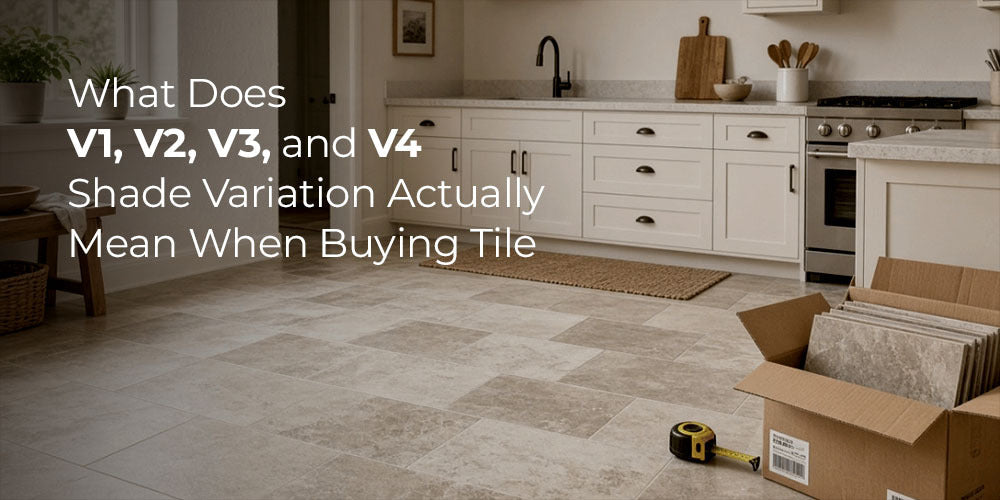
Buying tile online can be confusing because the product photo you love may show only one piece, while your finished kitchen, bathroom, or living room may contain dozens or hundreds of tiles. Once several cartons are opened, some tiles may look almost identical. Others may show noticeably different colors, veining, grain, or pattern movement. That difference is often intentional, and the V1, V2, V3, or V4 shade-variation rating helps explain it.
Understanding that rating before ordering can prevent one of the most common tile-shopping surprises: expecting every piece to match the sample exactly. A homeowner may see a calm beige stone-look tile online, order a V4 product, and then worry when darker, lighter, or more strongly patterned pieces arrive. In many V4 collections, that variation is part of the design rather than a defect.
The rating also affects how you should sample, order, inspect, and lay out the tile. This guide explains each level in easy language and shows how to use shade variation as a design tool rather than discover it after installation begins.
What Is Tile Shade Variation?

Shade variation describes the degree of visual difference you can expect within a tile and from one tile to another in the same product line. Depending on the design, those differences may appear in color, tone, veining, speckling, wood grain, stone movement, or decorative pattern.
Manufacturers commonly communicate this range with a V rating. The basic idea is simple:
|
Rating |
Variation level |
What you should expect |
|
V1 |
Low / consistent |
Tiles look very similar from piece to piece. |
|
V2 |
Moderate |
Small but noticeable differences appear, often within individual tiles. |
|
V3 |
High |
Color and pattern vary noticeably within and between pieces. |
|
V4 |
Random / considerable |
Tiles can differ significantly; the overall installation is intentionally varied. |
The V rating is about appearance, not durability, water resistance, slip resistance, tile strength, or overall product quality. A V4 porcelain tile is not automatically better or worse than a V1 porcelain tile. It simply creates a different visual result.
V1 Tile: When You Want a Clean, Consistent Look
V1 represents very little shade or pattern variation. Individual pieces are designed to look highly consistent, so the finished surface has a controlled and uniform appearance. This can work especially well in minimalist bathrooms, commercial interiors, clean contemporary kitchens, or projects where the designer wants the furniture and architecture to receive more attention than the floor.
A V1 rating does not mean every tile will be digitally identical. Small manufacturing differences can still occur, and grout, lighting, tile direction, and surrounding colors can affect perception. But compared with the other ratings, V1 gives buyers the strongest expectation of consistency.
Choose V1 when your priority is predictability. If you would be bothered by seeing a noticeably darker tile in the middle of an otherwise uniform floor, a low-variation product may suit you better.
V2 Tile: Subtle Movement Without a Busy Floor
V2 introduces more visible variation while keeping the overall installation relatively controlled. You may notice changes in tone, markings, or surface detail within individual pieces, but the floor usually still reads as one coordinated color family.
This is a useful middle ground for homeowners who find perfectly uniform tile too flat but do not want dramatic variation. A stone-look porcelain tile, for example, may use gentle shifts in texture and tone to feel more natural without making each piece look unrelated to the next.
V2 works well in kitchens, bathrooms, entryways, and larger living spaces where subtle movement can prevent a large tiled surface from feeling repetitive.
V3 Tile: Noticeable Variation Becomes Part of the Design
With V3, buyers should expect clearly visible differences both within individual tiles and from tile to tile. One piece may be lighter, another may contain stronger veining, and another may show a different balance of colors. When installed together, those differences create depth and a more natural or handcrafted appearance.
V3 is common in designs inspired by materials that naturally vary, such as stone, marble, aged surfaces, and some wood-look tiles. It can make a large floor feel richer because the eye does not see the same graphic repeated again and again.
The trade-off is that layout planning becomes more important. If several dark or strongly patterned pieces are installed next to each other by accident, one section of the room may look visually heavier. Dry-laying tiles from several cartons before installation allows the installer to distribute the variation more naturally.
V4 Tile: Expect the Unexpected
V4 represents the strongest level of visual variation. Considerable differences from tile to tile are intentional. Colors, markings, veining, and pattern intensity may change enough that individual pieces can look surprisingly different when viewed separately.
This is exactly why buying V4 tile based on one sample can be misleading. The sample can show you the finish and one possible color combination, but it cannot show the complete range of the collection.
V4 products can create some of the most distinctive floors and walls. They are useful when the goal is to reproduce the unpredictable character of natural stone, handmade tile, weathered surfaces, or highly varied decorative materials. But buyers must be comfortable with variation before ordering. If you want every tile to closely resemble the product hero image, V4 may not be the right choice.
When comparing options, browse the Floors Center tile collection and open individual product specifications rather than choosing by thumbnail alone.
Why One Tile Sample Can Give You the Wrong Impression

A sample is useful, but its usefulness depends on what you are trying to learn. One piece can help you judge finish, texture, approximate color, and how the surface responds to your room lighting. It cannot reliably demonstrate the full visual range of a V3 or V4 collection.
This becomes particularly important with marble-look porcelain. The sample you receive might contain a quiet section of veining, while other tiles in the collection may have much stronger movement. With wood-look tile, one plank might appear light and clean while other planks include darker knots or grain.
For high-variation products, review several product images, room scenes, manufacturer shade information, and multiple physical pieces when possible. If the final project is large or visually important, seeing several samples is more informative than judging the collection from one tile.
Floors Center carries extensive porcelain tile and ceramic tile selections, making it possible to compare products with very different visual personalities.
Shade Variation Is Not the Same as a Shade-Lot Difference
This distinction can save homeowners from an expensive ordering mistake. V1-V4 describes the intended visual variation of a product. A production or shade-lot difference refers to changes that may occur between separate manufacturing runs.
Even a tile designed to have substantial V4 variation should still be ordered carefully. If you buy most of the material today and then return months later for more, the new production run may not coordinate exactly with the original shipment.
That is why it is wise to calculate the project quantity carefully and include appropriate extra material for cuts, breakage, layout selection, and future repairs. The exact overage depends on room shape, tile size, pattern, and installer recommendations. Complex layouts generally create more waste than simple straight installations.
Why You Should Mix Tiles From Multiple Cartons
Opening one carton, installing every tile from it, and then moving to the next carton can create visible blocks of color or pattern. This is especially risky with V3 and V4 products.

A better approach is to open several cartons before installation and mix pieces across the work area. Step back and look at the floor before tiles are permanently set. Rotate or relocate pieces that create unwanted clusters.

This does not mean trying to make a V4 floor look like V1. The goal is to distribute the intended variation so the finished installation feels balanced rather than accidentally grouped.
Room Size Changes How Shade Variation Feels
The same V rating can feel different depending on the size of the room and the size of the tile. In a small powder room, only a limited number of large tiles may be visible, so one strongly contrasting piece can attract significant attention. In a large open living area, the same variation may spread across dozens of pieces and feel more natural.
Large-format tile also means each individual graphic occupies more visual space. A dramatic vein on a 24x48 tile can become a major design feature. Smaller tiles or mosaics break the visual field into many pieces, which changes how variation is perceived.
Size also changes the number of pieces and grout joints visible in a room. Read our tile size guide for floors and walls to compare mosaics, standard formats and large-format tile.
If you are considering small-format patterns, explore the Floors Center mosaic tile collection. Mosaics can intentionally combine multiple tones, materials, or shapes, making variation part of the pattern rather than an isolated surprise.
How Grout Color Changes the Effect of V1-V4 Tile
Grout can either calm shade variation or make each tile stand out more clearly. A grout color close to the dominant tile color tends to connect the pieces visually. A contrasting grout outlines every tile and can make differences between adjacent pieces more noticeable.
For a highly varied stone-look floor, matching grout can help the entire installation read as one surface. For a decorative wall where you want every shape visible, contrast may be intentional.
Do not choose grout from the tile sample alone. Lay several pieces together and test how the grout color behaves against the lightest, darkest, and most strongly patterned tiles in the range.
Grout-line width also changes how clearly each tile is outlined. Our guide to rectified vs. pressed tile explains why tile edges affect the finished grout-line appearance.
Does a Higher V Rating Mean More Maintenance?
No. Shade variation itself does not determine how difficult a tile is to clean. Maintenance depends more on the material, finish, texture, grout, installation location, and manufacturer care requirements.
Because finish and texture affect cleaning differently from shade variation, compare those features separately in our guide to matte, glossy and textured tile finishes.
However, variation can affect how the floor looks between cleanings. A multi-tonal V3 or V4 matte floor may visually disguise minor dust, crumbs, or everyday marks better than a very uniform dark or glossy surface. That is a visual effect, not a substitute for cleaning.
For busy kitchens, bathrooms, entryways, and family spaces, evaluate shade variation alongside slip resistance, surface texture, grout color, water exposure, and cleaning requirements. Floors Center’s floor tile selection includes porcelain and ceramic options designed for a range of residential and commercial uses.
A Simple Buying Checklist Before You Order
- Find the V rating in the product or manufacturer specifications.
- Decide whether you want a consistent surface or visible natural-looking variation.
- For V3 and V4, do not judge the full range from one sample.
- Look at several product images and room scenes when available.
- Consider how grout color will change the appearance of the variation.
- Order enough material at one time, including suitable overage for cuts and future repairs.
- Before installation, inspect the shipment and mix pieces from multiple cartons.
- Dry-lay strongly varied tiles so unwanted color or pattern clusters can be corrected before setting.
Which Rating Should You Choose?
There is no best V rating for every home. The right choice depends on the experience you want from the finished surface.
Choose V1 when consistency and predictability matter most. Choose V2 when you want gentle movement without a strongly varied floor. Choose V3 when natural-looking differences and richer visual depth are desirable. Choose V4 when you actively want substantial variation and understand that individual pieces may look quite different.
The most important rule is to buy the variation intentionally. A V4 floor can look beautiful when the homeowner expects variation, reviews the range, and plans the layout. The same floor can become disappointing when the buyer expected every tile to match a single sample.
Final Thoughts
V1, V2, V3, and V4 are not complicated once you understand what the scale is telling you. They are a preview of how consistent or varied the finished tile installation is intended to appear.
The rating helps you answer a much more useful question than “Do I like this one sample?” It helps you ask, “Will I like an entire room made from the full range of this tile?”
That distinction matters. V1 can create a calm, controlled background. V2 introduces subtle life. V3 brings noticeable movement and natural character. V4 makes variation one of the main features of the design.
Before placing an order, check the shade rating, review multiple pieces where possible, think about room size and grout color, and plan to mix tiles from several cartons. Those simple steps can prevent surprises and help the finished installation look intentional from the first tile to the last.
Browse Tiles at Floors Center to compare porcelain, ceramic, mosaics, natural stone, and other tile options for floors, walls, kitchens, bathrooms, showers, and commercial spaces.
Frequently Asked Questions
Q) Is V4 tile lower quality than V1 tile?
A) No. V1-V4 describes visual shade and pattern variation, not product quality. A V4 tile can be a premium product intentionally designed with considerable variation.
Q) Does V1 mean every tile will look exactly the same?
A) V1 indicates very consistent color and appearance, but minor manufacturing and visual differences can still occur. Always inspect the actual material before installation.
Q) Should I order a sample of a V4 tile before buying?
A) Yes, but remember that one sample cannot represent the full V4 range. Review multiple product images and, when possible, several physical pieces before making a large purchase.
Q) Why should installers mix tiles from different boxes?
A) Mixing cartons helps distribute color and pattern variation across the room. This is especially important with V3 and V4 products, where installing one carton at a time can create unintended clusters.
Q) Which shade variation is best for a natural stone look?
A) V3 and V4 often work well when the design is intended to reproduce the irregular character of stone, marble, wood, or handcrafted surfaces. The best choice depends on how much variation you personally want to see.