

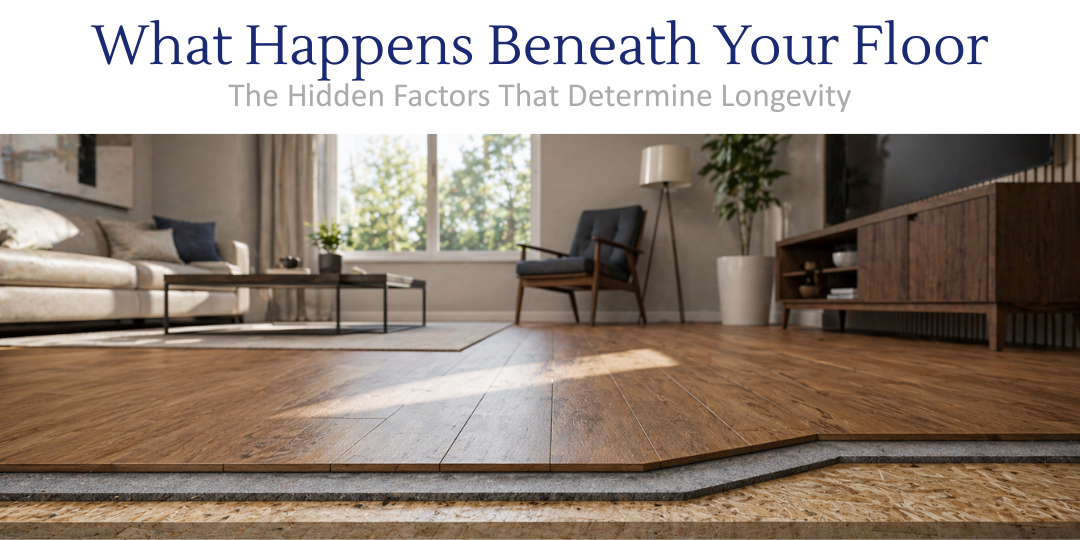
When homeowners invest in new flooring, most of the attention goes to what’s visible color, texture, finish, and overall design. But what truly determines whether a floor lasts five years or twenty is rarely seen.
The real story lies beneath the surface.
From subfloor conditions to moisture levels and installation precision, there are several hidden factors that directly influence flooring performance. Ignoring these elements can lead to premature wear, structural issues, and costly repairs even when high-quality materials are used.
At Floors Center, we believe that long-lasting flooring starts with understanding what happens beneath your floor. Because durability isn’t just about the product, it’s about the foundation supporting it.
Why the Foundation Matters More Than the Finish

A floor is only as strong as what it sits on.
No matter how premium the material, whether hardwood, vinyl, tile, laminate, or carpet, its performance depends heavily on the surface beneath it. A poorly prepared base can compromise even the most durable flooring options.
This is why two homes with identical flooring can have completely different outcomes. One remains stable and visually consistent for years, while the other develops issues like gaps, uneven wear, or movement.
The difference is almost always below the surface.
Understanding the Subfloor: The Structural Backbone
The subfloor is the layer directly beneath your finished flooring. It acts as the structural base that supports everything above it.
Common subfloor types include:
- Plywood.
- Oriented strand board (OSB).
- Concrete slabs.
Each type behaves differently and must be properly evaluated before installation.
A well-prepared subfloor should be:
- Level: Prevents uneven wear and pressure points.
- Clean: Ensures proper adhesion or locking.
- Dry: Reduces the risk of moisture-related damage.
- Stable: Supports weight without flexing
If these conditions are not met, the flooring above may:
- Shift or move.
- Develop cracks or gaps.
- Wear unevenly.
- Lose its structural integrity.
Subfloor preparation is not optional it is one of the most critical steps in achieving long-lasting floors.
Moisture: The Most Common Cause of Flooring Failure

Moisture is often invisible, but its impact on flooring can be severe.
Even in homes that appear dry, moisture can exist in:
- Concrete slabs.
- Wooden subfloors.
- Indoor air humidity.
- Seasonal environmental changes.
Over time, excess moisture can lead to:
- Warping in hardwood floors.
- Expansion and contraction issues.
- Mold growth beneath the surface.
- Adhesive failure in glued installations.
This is especially important in areas like basements, kitchens, and entryways.
For moisture-prone environments, homeowners often benefit from flooring solutions designed to handle these conditions
Managing moisture is not just about prevention, it’s about selecting materials that can tolerate real-life conditions.
Moisture problems are not limited to the interior of a property. In the surrounding landscape, poor drainage and compacted ground can also affect tree root health and soil stability
The Role of Underlayment: Comfort Meets Performance
Between the subfloor and the finished flooring lies another critical layer, underlayment.
While often overlooked, underlayment plays a key role in:
- Absorbing impact and reducing noise.
- Providing cushioning underfoot.
- Improving insulation.
- Acting as a moisture barrier.
The type of underlayment used must match the flooring material. For example:
- Floating floors require specific padding.
- Tile installations may require rigid backing.
- Hardwood may need moisture barriers depending on the location.
Using the wrong underlayment, or skipping it entirely, can reduce comfort and accelerate wear over time.
Installation Precision: Where Small Errors Become Big Problems
Even the highest-quality flooring can fail if installed incorrectly.
Installation is not just about placing planks or tiles it involves precise measurements, spacing, and alignment.
Common installation issues include:
- Insufficient expansion gaps.
- Misaligned planks or tiles.
- Uneven adhesive application.
- Poor locking system engagement.
These mistakes may not be immediately visible, but over time they can cause:
- Buckling.
- Gapping.
- Surface irregularities.
- Structural weakness.
Professional installation ensures that the flooring performs as intended under real-world conditions.
Movement and Expansion: A Natural Process
All flooring materials respond to environmental changes. Temperature and humidity cause materials to expand and contract.
This is especially true for:
- Hardwood flooring.
- Laminate flooring.
- Some types of engineered hardwood.
If flooring is installed without allowing for this natural movement, it creates internal stress. Over time, this leads to:
- Warping.
- Cracking.
- Joint separation.
Long-lasting floors are not rigid they are installed in a way that allows controlled movement without visible damage.
Load Distribution and Structural Stress
Another hidden factor that affects flooring longevity is how weight is distributed across the surface.
Heavy furniture, appliances, and constant foot traffic create pressure points. If the subfloor or installation is uneven, this pressure is not distributed properly.
Over time, this can result in:
- Indentations.
- Surface wear in specific areas.
- Structural fatigue.
Durable flooring materials combined with proper installation help distribute weight evenly, reducing long-term stress.
Traffic Patterns: The Real Test of Durability
Not all areas of a home experience equal use. Entryways, hallways, and kitchens often see significantly more traffic than bedrooms or dining areas.
These high-traffic zones are where flooring performance is truly tested.
Materials that perform well in these areas include:
Understanding how different areas of your home are used allows for smarter flooring choices that extend lifespan.
Environmental Conditions and Climate Impact
Climate plays a major role in how flooring behaves over time.
In regions with:
- High humidity: materials may expand.
- Dry conditions: materials may contract.
- Temperature fluctuations: stress increases.
Choosing the right flooring material for your environment is essential.
For example:
- Engineered hardwood offers better stability than solid wood.
- Vinyl flooring performs well in varying conditions.
- Tile remains unaffected by moisture changes.
Matching flooring to climate ensures consistent performance year-round.
The Importance of Maintenance from Day One
Even the most durable flooring requires proper care.
Maintenance is not just about keeping floors clean, it’s about preserving their structure and surface.
Best practices include:
- Regular sweeping to remove abrasive dirt.
- Use protective pads under furniture.
- Cleaning spills promptly.
- Avoiding excessive moisture.
Neglecting maintenance accelerates wear and reduces lifespan, regardless of material quality.
Choosing Flooring with the Full System in Mind
One of the most common mistakes homeowners make is choosing flooring based solely on appearance.
A better approach is to consider the entire system:
- Subfloor condition.
- Moisture exposure.
- Installation method.
- Daily usage.
- Maintenance expectations.
This ensures that the flooring performs well not just visually, but structurally.
Why Floors Center Focuses on More Than Just Products
At Floors Center, we understand that long-lasting floors are the result of informed decisions not just product selection.
We help homeowners evaluate:
- The condition of their existing subfloor.
- The environmental factors affecting their home.
- The best flooring category for their needs.
- Long-term performance expectations.
Our goal is to ensure that every flooring investment delivers lasting value not just short-term appeal.
Final Thoughts
What happens beneath your floor is just as important as what you see on the surface.
Subfloor preparation, moisture control, underlayment selection, and installation precision all play a critical role in determining how long your flooring will last.
Homeowners who understand these hidden factors are better equipped to make decisions that prevent common problems and extend the life of their floors.
Because in the end, long-lasting flooring isn’t just about choosing the right material it’s about building the right foundation.