

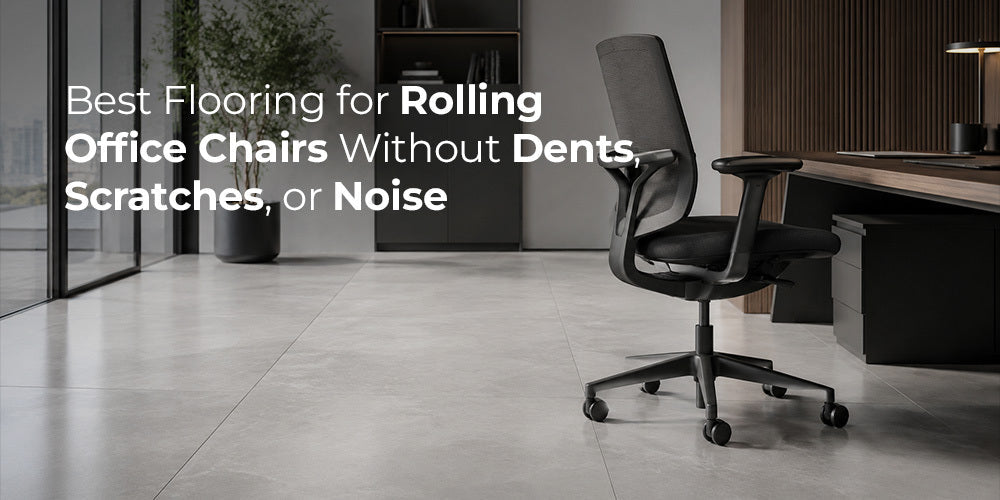
A rolling office chair places more pressure on a floor than it may seem. Each small wheel carries part of the user’s weight, and the chair repeatedly travels across the same limited area. Over time, this movement can leave dents, scratches, dull spots, separated planks, or noisy rolling tracks.
The best flooring for rolling office chairs must do more than look professional. It should resist concentrated wheel pressure, handle repeated movement, reduce noise, and remain easy to clean. The chair’s wheels, flooring installation, subfloor, and daily maintenance also affect performance.
No flooring material leads every category. Porcelain tile offers exceptional resistance to dents and surface wear, but hard wheels may create noise. Rubber flooring is much quieter, while commercial-grade vinyl offers a practical balance of comfort, appearance, and durability. This guide compares the leading choices for home offices, meeting rooms, workstations, and busy commercial spaces.
Why Rolling Office Chairs Damage Flooring
An office chair creates both rolling and concentrated loads. Although the chair and user may not appear unusually heavy, the total weight is distributed across a few small wheels. The contact area between each wheel and the floor is limited, which increases pressure at those points.
Unlike a table or cabinet, an office chair doesn’t stay still. It moves forward, backward, and sideways throughout the day. This repeated movement creates friction across the same area. Armstrong Flooring explains that a wheel’s bearing surface can be deceptively small and may produce more compressive force than expected. That is why rolling-load performance matters when selecting resilient flooring.
Concentrated Pressure Can Cause Dents
Soft flooring may compress beneath chair casters. A high-quality floor can recover from brief pressure, but repeated or long-term loading may create permanent indentations. A thick floor is not automatically more dent-resistant; density, surface layer, core construction, and installation all matter.
- Narrow, damaged, or hard chair wheels increase pressure.
- A heavy chair and user create a greater rolling load.
- Soft cores and thick cushioned backings may compress.
- A weak or uneven subfloor can make the finish flex.
- Products not rated for caster traffic may wear prematurely.
Dirt Under the Wheels Causes Scratches
Office chair wheels collect sand, dust, hair, and small pieces of grit. When the chair moves, this debris may be dragged across the surface. Fine scratches can gradually reduce the finish’s shine and create a dull circle around the desk. Dark, glossy, or solid-colored floors often reveal this wear more clearly than matte or patterned surfaces.
Loose Planks Can Move or Separate
Click-lock flooring needs a firm, level base. If the subfloor is uneven, rolling pressure can cause planks to flex. Continuous movement may stress the locking system, leading to clicking sounds, broken joints, or small gaps. Poor subfloor preparation, insufficient expansion space, unsuitable underlayment, or incorrect installation can shorten the floor’s service life.
Hard Surfaces Increase Rolling Noise
Dense surfaces such as porcelain tile can produce noticeable wheel noise. A chair may sound especially loud in an office with bare walls, hard furniture, and few sound-absorbing materials. Rubber and carpet tile absorb more impact sound, while luxury vinyl and cork generally fall between tile and carpet.
What Makes Flooring Suitable for Office Chairs?
Before comparing materials, consider dent resistance, scratch protection, rolling comfort, sound control, stability, cleaning needs, repairability, and the manufacturer’s warranty. Product specifications related to static loads, rolling loads, indentation, and commercial traffic are more useful than broad claims such as “highly durable.”
Questions to Ask Before Buying
- Is the exact product approved for continuous caster-chair traffic?
- What rolling-load or indentation limits are published?
- Does the warranty require a chair mat or particular caster type?
- Is glue-down or floating installation recommended for the room?
- Will an acoustic underlayment remain firm enough beneath rolling loads?
- Can individual damaged planks or tiles be replaced?
1. Porcelain Tile: Best for Maximum Dent Resistance
Porcelain floor tile is one of the strongest choices for rolling office chairs. It will not develop caster-shaped dents, and a suitable commercial-grade product can withstand heavy traffic for many years. It is easy to clean and available in wood, concrete, marble, and stone looks.
The main concern is noise. Plastic wheels may produce a hard rolling sound, especially when passing over grout joints. Large-format tile can reduce the number of joints and create a smoother path. Tile can also feel cold and firm, so an anti-fatigue mat may help near a standing desk.
Soft polyurethane casters can reduce noise and scuffing. The substrate must be flat so adjacent tile edges do not create bumps. For offices that need maximum dent resistance, porcelain is a dependable long-term choice.
Verdict: Best for dent resistance and long service life, but caster choice matters for noise control.
2. Commercial Luxury Vinyl: Best Overall Balance

Commercial-grade luxury vinyl is one of the best flooring options for rolling office chairs when appearance, comfort, sound, and cost must be balanced. It feels warmer and quieter than porcelain but is easier to roll across than thick carpet. Realistic wood, stone, and concrete designs suit both home and commercial offices.
For busy commercial spaces, properly specified glue-down luxury vinyl may offer better stability than some floating floors. It stays closely connected to the prepared subfloor and is less likely to flex under repeated rolling loads. Rigid-core vinyl can work well in home offices, but the exact product must be approved for the intended use.
A thicker wear layer often supports heavier use, but it does not tell the whole story. Review the top coat, indentation resistance, rolling-load approval, core construction, installation requirements, and warranty exclusions.
Verdict: Best overall option for many home and commercial offices when the product is rated for the expected rolling load.
3. Rubber Flooring: Best for Reducing Chair Noise

Rubber flooring is an excellent choice where sound, comfort, and slip resistance matter. Its resilient surface absorbs more rolling impact than tile, laminate, or hardwood. It can work especially well in call centers, creative studios, shared offices, upstairs rooms, and spaces where chairs move frequently.
Some rubber surfaces create more rolling resistance than smooth vinyl, and traditional design options may be limited. Not every rubber product is intended for office casters, so rolling-load requirements should be checked before purchase.
Verdict: Best for quiet movement and underfoot comfort, especially in active shared workspaces.
4. Laminate Flooring: Best Affordable Wood Look
Laminate provides the appearance of wood at a more accessible price than many hardwood products. Its dense surface can perform well in a home office when it has a suitable wear rating and the subfloor is properly prepared.
Laminate may sound hollow when the installation or underlayment is unsuitable. Hard chair wheels can also produce noticeable rolling noise. If the subfloor is not level, constant rolling may stress the plank joints. A clear hard-floor chair mat or soft polyurethane casters can add protection.
Verdict: A cost-effective home-office choice, but installation quality and caster protection are essential.
5. Engineered Hardwood: Best for a Premium Office
Engineered hardwood creates a warm, professional appearance for executive offices, libraries, meeting rooms, and home workspaces. Its layered construction can offer dimensional stability, but the visible surface is still real wood.
Wood can scratch, dent, and lose finish under repeated chair movement. Softer species and glossy finishes tend to show wear sooner. Use soft casters approved for wood floors or a quality chair mat with a smooth, non-staining backing. Remove grit frequently and never drag furniture across the finish.
Verdict: Best for premium appearance, but not the most worry-free option for continuous unprotected chair movement.
6. Carpet Tile: Best for Quiet, Comfortable Offices
Carpet tile is widely used in commercial offices because it combines sound absorption, comfort, and modular repair. Low-pile commercial carpet tile allows easier chair movement than thick residential carpet, and damaged sections can often be replaced individually.
Choose a product tested or rated for caster-chair use. Deep pile, loose yarns, weak installation, or unsuitable backing may interfere with wheels. Carpet tile also needs more attention after coffee, ink, or food spills than porcelain or vinyl.
Verdict: Best for acoustic comfort and modular repair when a low-pile, caster-rated product is selected.
7. Cork Flooring: Best for Natural Comfort
Cork is naturally resilient, warm, and sound-absorbing. It can create a comfortable home office where reduced noise matters more than maximum dent resistance. Because cork is softer than tile, laminate, and many commercial vinyl products, narrow casters may leave impressions beneath a heavy chair. A compatible protective finish, wide soft wheels, or chair mat is usually advisable.
Verdict: Comfortable and quiet, but better for light office use with appropriate protection.
Flooring Comparison for Rolling Office Chairs
|
Flooring |
Dent |
Scratch |
Noise |
Rolling |
Best Use |
|
Porcelain tile |
Excellent |
Excellent |
Fair |
Excellent |
Heavy-use offices |
|
Commercial luxury vinyl |
Very good |
Very good |
Good |
Excellent |
Home and commercial offices |
|
Rubber flooring |
Very good |
Good |
Excellent |
Good |
Shared or noise-sensitive spaces |
|
Laminate |
Good |
Good |
Fair |
Excellent |
Budget home offices |
|
Engineered hardwood |
Fair |
Fair |
Fair |
Excellent |
Premium protected offices |
|
Carpet tile |
Good |
Good |
Excellent |
Fair to good |
Open and commercial offices |
|
Cork |
Fair |
Fair |
Excellent |
Good |
Light-use home offices |
Ratings are general comparisons. Performance varies by construction, finish, installation, caster design, chair weight, cleaning, and product warranty.
Which Flooring Is Best for Your Office?
Best for a Home Office
Commercial-grade luxury vinyl is often the most practical option because it creates a residential look, feels more comfortable than tile, and allows easy chair movement. Laminate is another useful choice when the budget is limited and moisture exposure is low.
Best for a Busy Commercial Office
Glue-down commercial luxury vinyl, porcelain tile, rubber flooring, or caster-rated carpet tile can perform well. The choice should reflect traffic, acoustics, maintenance resources, and design goals.
Best for an Upstairs Office
Rubber, cork, carpet tile, or acoustically rated vinyl may reduce impact sound. The entire floor and ceiling assembly affects sound transfer, so the finish alone cannot guarantee a quiet room below.
Best for Quiet Chair Movement
Rubber flooring and low-pile carpet tile provide strong sound control. Luxury vinyl is a useful middle ground when easy rolling is equally important.
Do Office Chair Wheels Matter?

The wrong casters can damage even durable flooring. Standard chairs often arrive with small, hard plastic wheels intended mainly for carpet. For hard floors, consider wide polyurethane casters designed for tile, vinyl, laminate, or wood. Rollerblade-style wheels spread pressure across a larger contact area and usually roll more quietly.
Replace wheels when they have sharp edges, stop rotating freely, collect debris in the axle, drag instead of roll, leave dark marks, or create a new scraping sound. A single stone trapped in a caster can scratch a much larger area.
Should You Use a Chair Mat?
A chair mat adds protection against scratches, scuffs, and concentrated wheel pressure, but it must suit the floor beneath it. Use a flat hard-floor mat on tile, vinyl, laminate, or wood, and a cleated mat designed for the correct carpet-pile height. Choose a non-staining material approved by the flooring manufacturer and cover the chair’s complete rolling area.
Avoid rough or chemically incompatible backings. Grit trapped beneath a mat may scratch the floor, while trapped moisture or an incompatible plasticizer can cause discoloration.
Installation Factors That Affect Performance
Subfloor Flatness
An uneven subfloor creates movement beneath planks and tiles. Repeated rolling can increase the risk of cracked joints, loose flooring, or clicking sounds.
Correct Adhesive
Glue-down products need an adhesive approved for the flooring, subfloor, environment, and expected rolling load. Allow the full required curing period before using furniture or chairs.
Suitable Underlayment
A thick, soft underlayment may improve sound but can allow excess movement beneath floating floors. Follow the exact flooring manufacturer’s instructions.
Expansion Space
Floating laminate and vinyl need the specified expansion space around walls and fixed objects. Improper spacing can make planks lift, separate, or press against surrounding structures.
How to Prevent Dents, Scratches, and Noise
- Choose flooring approved for rolling or caster-chair loads.
- Vacuum or sweep around the workstation regularly.
- Remove hair, grit, and debris from the wheels.
- Use a compatible chair mat when recommended.
- Follow installation and adhesive-curing instructions.
- Avoid dragging desks or cabinets across the floor.
- Use floor protectors under stationary furniture.
- Replace damaged planks or tiles before the problem spreads.
Common Buying Mistakes
Choosing by Appearance Alone
A beautiful wood or stone look does not confirm that the product can handle rolling loads. Technical specifications should guide the final decision.
Assuming Scratch-Resistant Means Scratch-Proof
Sharp debris, broken casters, and dragged furniture can damage any surface. Scratch resistance reduces risk; it does not eliminate maintenance.
Using Carpet Casters on Hard Floors
Small hard casters create unnecessary noise and concentrated pressure. Use wheels designed for the installed surface.
Adding Unapproved Underlayment
Extra cushioning can make some floating floors unstable beneath repeated rolling loads.
Ignoring the Warranty
Some residential warranties exclude caster-chair damage, rolling loads, or incompatible mats. Review the warranty before ordering.
Frequently Asked Questions
Q) What is the best flooring for rolling office chairs?
A) Commercial-grade luxury vinyl is the best balanced option for many offices because it combines smooth rolling, moderate sound control, design flexibility, and easy maintenance. Porcelain provides stronger dent resistance, while rubber and carpet tile offer better noise reduction.
Q) Will an office chair dent vinyl plank flooring?
A) It can. Risk depends on construction, indentation resistance, installation, chair weight, and caster width. Select a product approved for rolling loads and use suitable soft casters or a compatible chair mat.
Q) Can rolling office chairs scratch porcelain tile?
A) Porcelain is highly scratch-resistant, but trapped sand or metal debris may mark some finishes. Wheels can also scuff grout or catch on uneven joints, so regular cleaning remains important.
Q) Is laminate flooring suitable for office chairs?
A) Yes, suitable laminate can work in a home office. It needs a flat subfloor, correct underlayment, proper expansion space, and floor-safe casters. A chair mat can add protection.
Q) What flooring makes an office chair quieter?
A) Rubber flooring and low-pile carpet tile are among the quietest choices. Cork also absorbs sound well. Luxury vinyl is generally quieter than porcelain, laminate, or hardwood.
Q) Do I need a chair mat on luxury vinyl?
A) That depends on the product and warranty. Some manufacturers recommend mats or specific casters. If using a mat, make sure it is non-staining and approved for vinyl.
Q) What flooring will not dent under a heavy office chair?
A) Porcelain tile offers the strongest general resistance to caster-shaped dents. Commercial rubber, glue-down resilient flooring, and other dense commercial products may also perform well when rated for the load.
Q) How can I stop my office chair from scratching the floor?
A) Clean the wheels, remove grit from the workstation, replace damaged plastic casters with soft floor-safe wheels, and use a compatible chair mat when required.
Conclusion
The best flooring for rolling office chairs depends on which problem matters most. Porcelain tile offers excellent protection against dents and scratches. Commercial luxury vinyl provides the best overall balance of appearance, rolling comfort, sound, and durability. Rubber and carpet tile are strong choices for quieter offices, while laminate delivers an affordable wood look. Engineered hardwood creates a premium environment but needs greater protection.
The flooring material is only part of the solution. A level subfloor, correct installation, appropriate casters, regular cleaning, and a compatible chair mat can significantly improve long-term performance. Before buying, review the exact product’s rolling-load specifications, installation instructions, care guide, and warranty.
Find the right flooring for your workspace at FloorsCenter.com